

Diversification Re-engineered
Multi Asset Tactical View: November 2026


We are selectively positive on equities and commodities but cautious on bonds. In terms of equity sectors, we think biotech offers value amid M&A activity.
October: Rotation at play
October was a turbulent month for global equities, with Middle East tensions and renewed concerns over AI financing and valuations weighing on sentiment. These factors prompted a rotation from technology towards defensive and previously unloved areas. The UK and Europe posted modest gains, while the US edged lower, Japan underperformed and emerging markets fell sharply. Energy, consumer staples and health care advanced, while technology lagged. Global bonds recovered some of September’s losses as safe-haven demand lowered yields. Brent rose sharply on Hormuz supply risks, while gold fell below USD 3,900 as strong US data fuelled expectations of a December US Federal Reserve rate hike. Since month-end, some risks have been priced out: the clear US midterm results eased political uncertainty and oil retreated on hopes of de-escalation with Iran.
Our take: Selectively constructive
We remain constructive on global equities, as earnings have proven resilient, despite higher rates and renewed doubts about the AI investment cycle. In the US, the earnings backdrop remains supportive, but elevated valuations and concentration in AI-related stocks call for selectivity. We stay positive on Japan, backed by earnings upgrades and accommodative real rates, and maintain a modestly positive view on euro zone equities. Emerging markets continue to offer attractive valuations and earnings, despite greater sensitivity to the technology cycle.
In fixed income, we remain cautious based on systematic factors, although fundamentally yields are at increasingly attractive levels. Government bonds also provided renewed diversification during the recent equity sell-off. But sticky inflation and fiscal pressures caution against too constructive a stance for now. We also stay cautious on US high yield and emerging market hard-currency debt, despite some support from the economic backdrop. We remain constructive on commodities. Oil benefits from supply disruption, while constrained supply supports copper. We are more cautious on gold, as high real yields and a strong US dollar remain headwinds, despite longer-term support from central bank purchases and fiscal concerns. In currencies, we favour the dollar, supported by better carry, while stretched valuations limit further upside.
Tactical asset allocation views summary
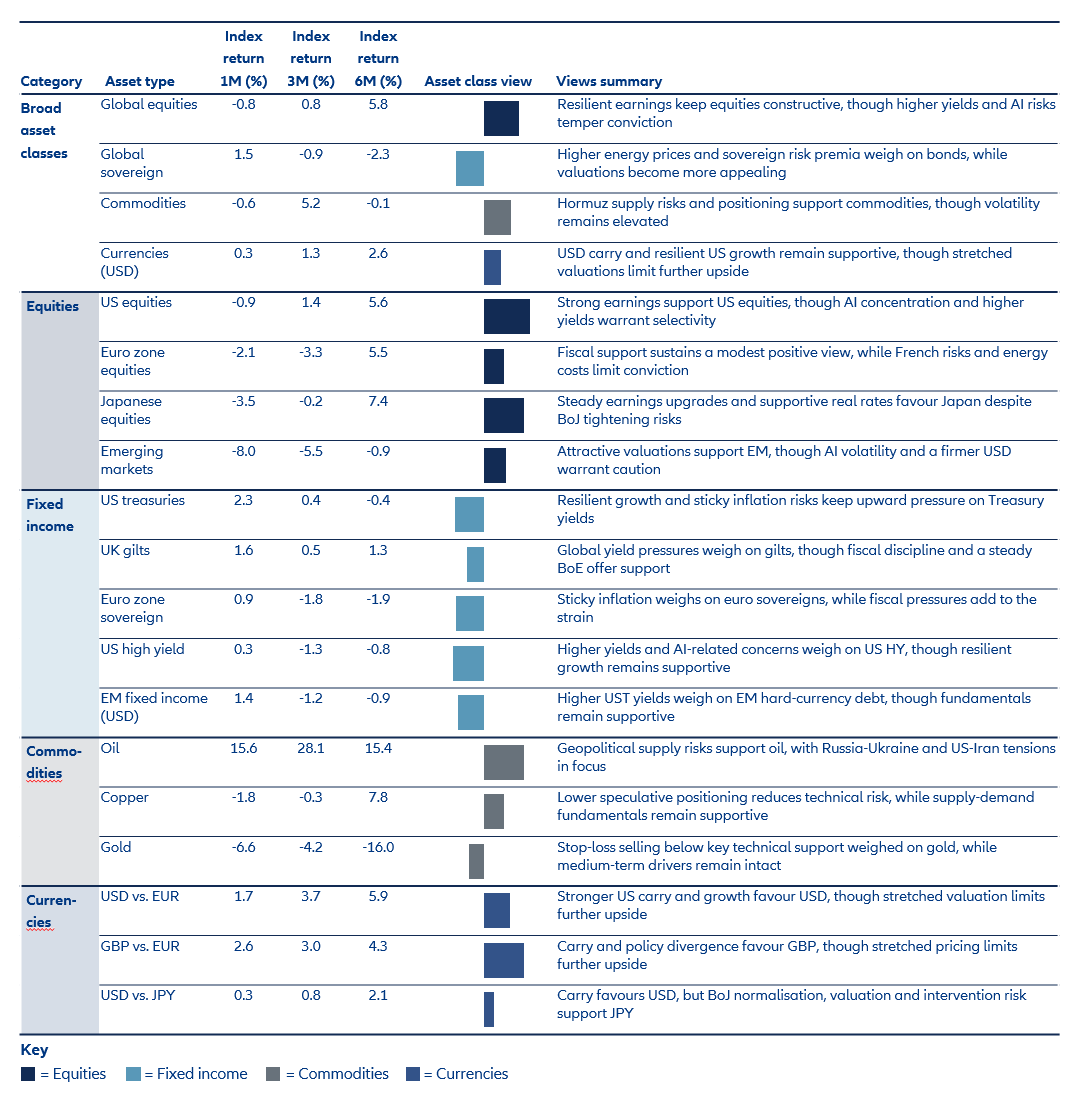
Source: Bloomberg Finance L.P.; data as of 30 October 2026. Past performance does not predict future returns. Global equities are represented by MSCI AC World Daily TR, Global sovereign by FTSE World Government Bond Index – Developed Markets in USD, Commodities by Bloomberg Commodity Index, Currencies (USD) by Bloomberg Dollar Spot, US equities by S&P 500 Index, Euro-zone equities by MSCI EMU Index (EUR), Japanese equities by TOPIX Index (JPY), Emerging markets by MSCI EM NR, US treasuries by J.P. Morgan US Government Bond Index, UK gilts by J.P. Morgan UK Government Bond Index, Euro-zone sovereign by J.P. Morgan EMU Investment Grade Index, US high yield by Bloomberg U.S. Corporate High Yield, EM fixed income by J.P. Morgan EMBI Plus Index, Oil by S&P GSCI Crude Oil, Copper by BBG Copper TR, Gold by GOLD SPOT $/OZ. For currencies, the US dollar (USD) and the British pound (GBP) are represented by each respective currency vs. the euro (EUR) as well as the USD vs. the Japanese yen (JPY).
Theme of the Month: Biotech equities
Big pharma faces patent expiries that could affect more than USD 500 billion in drug sales between 2026 and 2032, peaking at USD 158bn in 2031. To rebuild pipelines drugmakers are buying biotech innovation: biopharma merger and acquisitions in the first half of 2026 nearly equaled the full-year 2025 total Yet biotech valuations remain below their long-term average, warranting a closer look at the sector.
Patent expiries: average annual sales at risk to more than double in 2026-2032 compared with 2014-2025

Source: Evaluate - 2014-2025: World Preview 2023 (June 2023); 2026-2032: Norstella forecasting data provided by Evaluate, as published by PharmaVoice (8 October 2026). M&A: IQVIA, "Biopharma M&A: Mid-year 2026 update" (8 July 2026; majority-stake deals of USD 250m or more). Valuation: FactSet, S&P Biotechnology Industry Index, 1-year forward P/E of 17.7x vs. 19.8x average since 1996, as at 30 June 2026. "Sales at risk" = worldwide prescription sales in the year before patent expiry, allocated to the year of expiry; it is potential exposure to generic competition, not expected revenue loss. Averages: USD 75bn a year in 2026-2032 vs. USD 34bn in 2014-2025; 2023-2025 values are forecasts from the 2023 edition and the two editions differ (e.g. 2027: USD 80bn vs. USD 44bn). Total 2026-2032: USD 527bn (sum of the plotted values). Curve: least-squares exponential fit through all plotted values (about 6% p.a.); a descriptive fit, not a forecast. Forecasts are not a reliable indicator of future results.
Chart of the month: Rotation, not yet capitulation
Defensive stocks took the lead as momentum reversed in October

Source: Bloomberg Finance L.P., Allianz Global Investors, daily data from 30 Sep 2026 to 30 Oct 2026 as at 30 Oct 2026. Net total returns in USD, rebased to 100. Investors cannot invest directly in an index. The information above is provided for illustrative purposes only, it should not be considered a recommendation to purchase or sell any particular security or strategy or as investment advice. Past performance, or any prediction, projection or forecast does not predict future returns.
October saw a notable shift in equity factor leadership. The MSCI World Momentum Index, which has a significant tilt towards the technology and AI-related stocks that had led markets in recent months, fell 8.3% over the month, while the MSCI World Minimum Volatility Index gained 6.0%. The resulting gap of around 14 percentage points appears to reflect growing questions about whether the heavy investment in AI will deliver the expected returns, and pressure built towards month-end as tech earnings disappointed and equity volatility rose. Investors seemed to favour more defensive areas of the market, which tend to carry a larger weight in minimum volatility portfolios. As losses were largely concentrated in a relatively small group of large-cap names, the broader market proved more resilient than the headlines might suggest. While the sell-off points to increased nervousness, we would not necessarily read it as a fundamental turning point, as the longer-term case for AI still looks broadly supported in our view. The episode does, however, underline how strongly the market is currently focused on this single theme.