

How we invest sustainably
Footprint and handprint: measuring both sides of a company’s impact


Looking at a company’s footprint alone may not tell the whole story. Assessing both positive and negative impacts of a company's operations can help investors better identify risks, opportunities and sources of long-term value creation.
Exhibit 1: Differentiating footprint from handprint

Source: Allianz Global Investors – Sustainability Research, 2026
Shifting the narrative
Historically, sustainability assessments focused on a company’s negative environmental impacts, like emissions, pollution and resource depletion – ie, its “footprint”. The handprint concept arose to provide balance by recognising when its activities – including products and services – proactively benefit climate, nature and people. Handprint is often associated with solutions that support environmental and social goals, including the UN Sustainable Development Goals (SDGs) as shown in Exhibit 3.
Footprint and handprint are two sides of the same coin – determining the overall impact of a business on the world. Both are central to impact materiality assessments which underpin a growing number of regulatory frameworks.i
Why this matters for investors
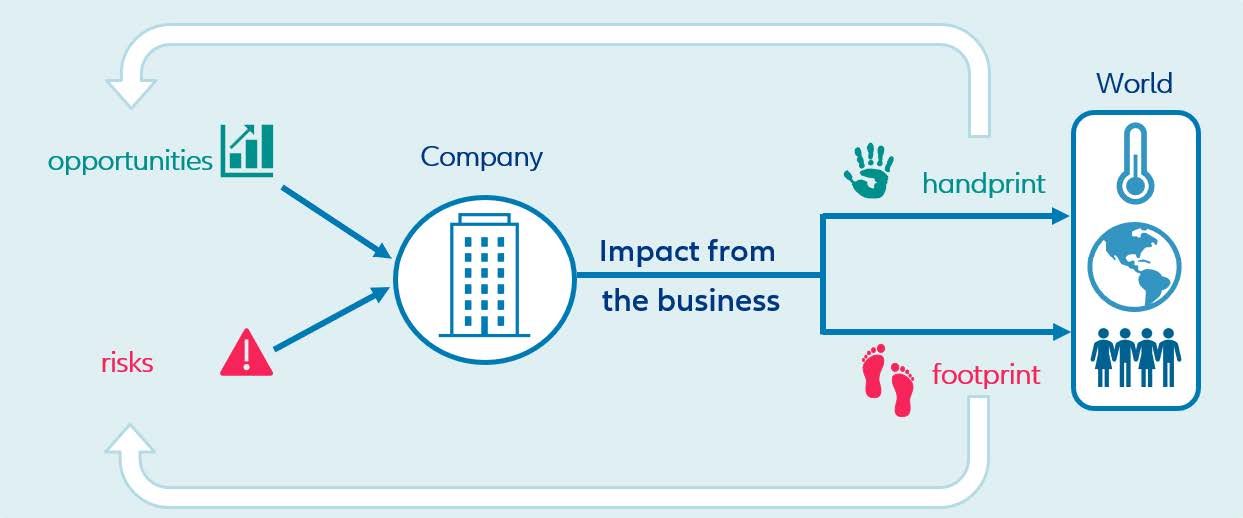
Investors should be considering impacts on investee companies, particularly the effect of financial impact on returns. This is where handprint and footprint come in – enabling assessment of financially material risks and opportunities. Footprint issues typically translate into risks, eg, regulatory, operational or reputational, while handprint is associated with growth and value creation, as shown below.
Exhibit 2: Double materiality = financial + impact materiality
Source: Allianz Global Investors, Sustainability Research, 2026
"To enable informed investment decision-making in both public and private markets, it is important to assess both the positive and negative financially material impacts of an investment opportunity. Identifying a company's footprint and handprint helps us understand both the material risks we need to anticipate and mitigate, as well as the potential opportunities that the company may be able to capture due to the sustainability-oriented solutions offered by its business model.
Both can be important drivers of resilience and long-term value creation. They also help investors understand how their portfolios contribute to environmental and social goals by distinguishing between companies that reduce harm through their operations and those whose products and services create positive outcomes."
Diane Mak, Head of Sustainability & Impact – Private Markets
Our approach to handprint and footprint
As we see transition solutions gain momentum as attractive long-term investments, handprint-oriented activities are increasingly aligned with structural growth themes like clean energy, sustainable agriculture, efficiency solutions and digital inclusion. Actively supporting the transition away from high emitters is central to sustainable, thematic and impact investing. Industry frameworks like the ICMA - Sustainable Finance Principles & guidance have helped strengthen the credibility and transparency of such approaches and facilitated use-of-proceed debt issuance via green bonds, social bonds and sustainability bonds.
Yet, a strong handprint alone is not sufficient. We need to recognise whether the achievement of positive impact overlooks significant negative impacts to assess appropriateness for inclusion in certain style funds.
We have built company profiles into our Sustainability Insights Engine (SusIE), as shown in Exhibit 3, which display a comprehensive range of metrics on separate footprint and handprint tabs, for example:
- Footprint metrics – controversy flags, individual factor scores from our PSSii (Proprietary Sustainability Scores), carbon and net-zero alignment KPIs, and a DNSH (Do No Significant Harm) assessment outcome.
- Handprint metrics – alignment with key taxonomies, sustainable investment classificationiii(according to our Proprietary Sustainable Investment Share), and SDG alignment shares with detailed positive contributions.
Exhibit 3: Utilities company contribution (handprint) to the SDGs

The numbers beside each SDG show the percentage of revenues in business activities that positively contribute to each SDG after a DNSH check. One business activity can contribute to several SDGs.
We believe that combining footprint and handprint into a single “net impact” assessment can obscure underlying opportunities and may not align with investor expectations. Investors need to be able to assess the magnitude of both the positive and negative impacts.
Footprint analysis and metrics have been the backbone of ESG approaches for a decade, with investors seeking to identify companies that are actively minimising or mitigating harm. Those reducing their footprints are often better positioned to manage risks, build resilience, and deliver long-term sustainable returns.
As the necessity and urgency to transition to a more resilient global economic model increases, we anticipate that more investors will push investee companies for clarification and measurement of their positive and negative impacts. The ability to reduce or mitigate footprint, while expanding handprint, is increasingly being aligned to value creation and protection, and we believe this is a hallmark of future-ready companies.
ii Allianz Global Investors, ESG ratings - are they still relevant? 2026
iii In accordance with our proprietary sustainable investment share – a KPI which assesses the share of company revenue that is tilted towards sustainable activities.