


Navigating Rates
Six themes for high yield bond investors in 2026


Technicals and fundamentals for high yield bonds remain supportive, and the AI debt boom, a potential increase in M&A and fallen angels provide opportunities – but stressed issuers and potential problems in non-bank lending underscore the need for active management.
Key takeaways
- High income and short duration combined with low expected default rates continue to make high yield attractive and a diversifier for many investors.
- Spreads appear tight but may be justified given the improving credit quality of US high yield bonds.
- The artificial intelligence (AI) investment cycle and refinancing needs should underpin issuance, but instability in non-bank lending and the growth of liability management exercises (LMEs) could present risks.
- We favour diversification across geographies, sectors and markets of issuance.
With few defaults, high yield bonds returned just above coupon in 2025, aided by a small rally in government bonds. US returns were slightly higher than those in Europe while emerging market bonds performed the best – tariffs impacted these markets less than had been feared following President Donald Trump’s election at the end of 2024.
It was nevertheless a volatile year for the asset class. Between February and April, in the market upheaval following the “Liberation Day” tariff announcement, high yield bond spreads widened 100 basis points – a sign that investors were pricing in significantly greater risk. That move almost entirely reversed between May and July, ending the year a little tighter than the beginning.
Despite these tight spreads, we believe the changing composition of the high yield market, resilient fundamentals and rising investor demand create a positive picture for high yield. However, risks on the horizon, mostly arising from late-cycle dynamics, warrant diligence. Here are our key themes for global high yield bond investors in 2026.
1. Despite potentially wider spreads, returns expectations are good
Based on analysis of predictions by several investment banks, the median 2026 forecast for US high yield returns is 6.2% with a range from 5% to 8.5%.1 Every estimate sees some spread widening offset by carry and the short duration of the asset class. Default rate estimates range from 1.5% to 3%. In our view these numbers appear sensible, with tail risks to the downside possibly coming from external economic or geopolitical shocks, and to the upside from an Operation Twist-type monetary stimulus in which the central bank seeks to lower the cost of borrowing by selling short-term bonds and buying long-term debt.
High yield spreads ended 2025 at tight levels, indicating these assets may be richly valued. With expected higher supply and more idiosyncratic risk, we would not be surprised to see spreads widening as investors demand more compensation for holding this kind of debt. The good news is that the impact on returns should be containable, given that spread duration for US high yield bonds is 2.8 years as at 31 December 2025 – a relatively low level. The US high yield index had a yield of 6.6% as at 31 December 2025, meaning that spread widening of 50 basis points would result in lowering returns to 5.2%, all other things being equal. Returns would also be influenced by factors including government bond yields – lower yields would boost returns – and defaults.
2. Credit quality in US high yield is high, possibly justifying spreads
The high yield market looks very different than in the era before the global financial crisis, primarily due to the improving credit quality of US-domiciled high yield bonds, which account for 62% of the global high yield market. Bonds rated BB – the highest credit quality in the high yield market – now account for more than 52% of index par in the US, up from 46% in 2019, while secured paper has grown to over a third of the index. In Europe, which accounts for 19% of the global market, BBs have been fairly constant at 71%. BBs also dominate emerging market high yield.
There has been a well-documented rise in non-bank lending. While a large degree is investment grade, some players have also focused on transactions that were previously financed in high yield markets – notably technology, software and more levered credits. Average leverage in private credit high yield transactions has been estimated by rating agencies at roughly twice the average for public high yield markets.
After the default of US auto parts company First Brands in 2025, there was a focus on underwriting standards across all leveraged finance – commentators looked to see if high yield private credit was a canary in the coalmine. A good way of tracking this part of the market is to look at business development companies (BDCs), which are a way investors can access this type of private debt. The Kroll Bond Rating Agency recently maintained a stable outlook for most BDCs in 2026. It said that as at the third quarter of 2025, only 8% of credits owned by BDCs were performing below expectations, of which only 1.4% were in stress – a reassuring picture – and significantly below long term CCC default rates.
At this point, while it is highly likely we will see increasing signs of stress, any broader shakeout in the system seems likely to be contained thanks to banks’ solid fundamentals, which allow them to absorb hits. The key thing to watch will be whether any blowups in the system make lenders more cautious, which could lead to tightening overall credit conditions in the system.
These developments provide some justification for tight spreads – especially when adjusting for duration, which, in the US high yield index, is close to a record low. When duration is considered, the difference in spread between US BB-rated bonds and US BBB-rated bonds – the lowest tier of investment grade – was 42 basis points as at 31 December 25 (Exhibit 1). This compares with a median of 40 basis points, indicating that current pricing is line with historic trends. The duration-adjusted spread difference between US BB-rated and the lower quality B-rated bonds is 60 basis points compared with a median of 56 basis points.
When accounting for duration, we think the current “tight” spreads can be considered reasonable, at least in terms of US high yield.
Exhibit 1: US high yield bonds’ duration-adjusted credit spread differential
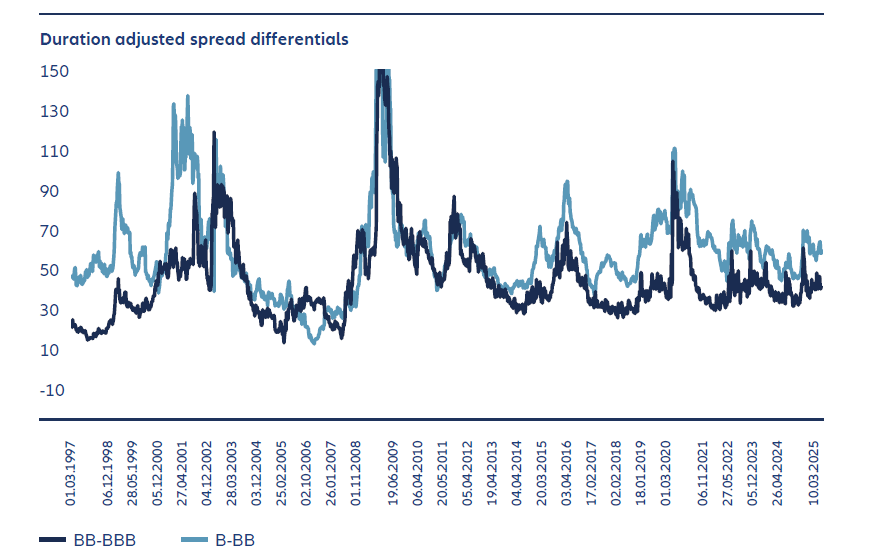
Source: Allianz Global Investors, ICE indices as at 31 December 2025
3. Most high yield issuance will be refinancing supporting technicals; M&A and fallen angels could provide opportunities
We expect the continuing of a trend in which the majority of high yield debt issuance will be for refinancing – a positive technical for investors. In addition, markets are expecting that funding for mergers, acquisitions (M&A) and leveraged buyouts will increase, bringing more supply to the market, and hopefully some additional yield as these will be new issuers.
It's worth noting that M&A often involves larger (investment grade) companies buying smaller ones which are sometimes high yield. This may create a positive dynamic for high yield investors: target companies tend to see bond prices rise and, if they do become investment grade, this also reduces supply in the market, providing a positive technical.
The wildcard is fallen angels – former investment-grade issuers that have been downgraded to high-yield status. A few names have been well flagged, but we believe other big names might enter the market too. As we saw with Warner Brothers this year, and Pemex, Occidental and Petrobras in the past, these bonds usually trade independently of the broader market and do not lead to a major repricing of other issuers in the index. Indeed, historically fallen angels have provided outsized returns for high yield investors – there are typically more sellers than buyers given that the investment grade market is about ten times the size of the high yield one.
We think refinancing needs and the rising appetite for mergers and buyouts will provide a supportive backdrop for high yield bond investors in 2026, while fallen angels could be an extra opportunity.
4. The AI debt boom will impact all bond markets and provide investment opportunities
Funding for artificial intelligence (AI) will account for a large and growing portion of debt finance in 2026. Like the dot-com boom and bubble in the late 1990s and early 2000s, the AI explosion will likely feature winners and losers. Success will partly depend on the availability of funding – in the early 2000s, many defaults resulted from liquidity drying up before projects were completed.
In the short term, the growth in AI-related debt will principally affect US investment grade bonds (JP Morgan predicts USD 1.81 trillion of US investment-grade issuance in 2026, with AI a key driver). However, high yield, leveraged loans, private debt and equity will also be involved. A side impact of the expected issuance is a likely increase in correlation between markets.
Overall, we think 2026 will prove the importance of asset selection to identify those borrowers with competitive products and an ability to manage liabilities.
5. LMEs have reduced defaults but underscore the need for active credit selection
Defaults as of 31 December 2025 for global high yield stood at 1.5%, almost entirely within CCC-rated bonds – the lowest main category of the high yield market. Our research team estimates a default rate in 2026 of about 2%, again focused in CCCs. This compares with a long-term average of 4.5%.
There is an argument that the default landscape for high yield has structurally changed. We have already noted that the US index is higher in quality. However, in the last few years we have also seen a change in how companies deal with financial stress – namely the rising use of liability management exercises (LMEs), in which a company or active group of creditors propose a proactive solution to a liquidity crisis ahead of time.
LMEs have been enabled by increasingly weak bond and loan covenants that allow various techniques to provide preferential terms for providers of new money compared with existing creditors. While LMEs may stave off imminent defaults, many of the companies that use these techniques go on to default within a couple of years. To put it simply, LMEs are likely to keep defaults subdued but also lead to lower recovery rates.
LMEs have rewritten the rules of investing. In the past, investors could opt for structurally senior or short-dated bonds to provide themselves with some protection in stressed situations, but this is no longer necessarily the case. There is increasing discussion about whether creditors can defend their interests by cooperating with other lenders, with the latest twist being allegations that these kinds of measures are akin to a cartel.
In this uncertain environment, we think that buying stressed credits and hoping for the best is unlikely to be a successful strategy. From an investing perspective, this should underscore a more defensive, active management style. While this approach could lead to periods of underperformance in strongly rallying markets, we believe that in an increasingly litigious market, fuelled by weak covenants, the downside risks are far greater.
6. Know what you don’t know – stay global, active and diversified
The return forecasts quoted above – 6.2% for US high yield with a range from 5% to 8.5% – are based on low defaults, a slight drop in interest rates and reasonable economic growth with little geopolitical risk. Yet one lesson we learnt from 2025 is that nothing is predictable. A casual read of the world press suggests more unpredictability in 2026. In this uncertain environment, we continue to advocate a global approach to investing to take advantage of differences in global growth, central bank policies, local industry dynamics and the widest range of potential investments. This, we believe, is the best way to generate resilient income within global high yield.
1 Source: AllianzGI analysis of predictions from Goldman Sachs, Morgan Stanley, Deutsche Bank, Citi, BNP Paribas and UBS.