


Outlook
Outlook 2027: Raising the bar









Foreword
The investment landscape is becoming more demanding. The forces reshaping the global economy are becoming more powerful and less predictable. Competition for capital is intensifying, while technological transformation, geopolitical shifts, energy security and demographic change are increasing the need for economic adaptation and resilience – and widening the gap between winners and losers. The broad market tailwinds that characterised much of the post-financial-crisis era can no longer be relied on.
The bar is higher. Success may depend on greater selectivity, longer investment horizons and a clearer understanding of the structural forces driving change. But investors also have more routes to opportunity. Looking beyond short-term market narratives can help identify the themes, businesses and assets best positioned to create value over time.
Meeting that challenge calls for a broader toolkit. Opportunities can be found across asset classes, regions and investment styles, with public and private markets providing complementary ways to access the same long-term themes. The task is to build portfolios capable of adapting as the opportunity set evolves.
In the pages that follow, our investment experts share their perspectives on the risks, themes and opportunities they believe will shape markets in 2027 and beyond.

Michael Krautzberger
CIO Public Markets

Edouard Jozan
Head of Private Markets
Key takeaways
- The economic cycle looks set to remain resilient, supported by AI investment and government spending, though inflation and competition for scarce capital are likely to raise borrowing costs. Investors will need to be selective: weaker borrowers face pressure, and the return threshold for all asset classes is rising.
- The AI story is shifting from promise to proof, favouring businesses using the technology profitably. Opportunities span Europe and Asia Pacific, but visible earnings, strong cash flows and sustainable dividends will increasingly distinguish the winners.
- Higher yields are restoring fixed income’s appeal, particularly in selected credit markets and emerging market debt. Opportunities are selective, but clearer signs that interest rates have peaked and growth is slowing could favour government bonds.
- Changing correlations are testing traditional equity and bond diversification. We believe commodities, currencies and active allocation can help navigate varied outcomes, with supply constraints supporting oil and copper and the US dollar retaining a tactical diversification role.
- Private credit and private equity demand greater selectivity. Borrower fundamentals, manager expertise, disciplined underwriting and lender protections remain critical, while completed exits, cash distributions and operational improvements will underpin a sustained recovery in private equity.
- Energy security, electrification and AI offer long-term opportunities across power grids, storage, data centres and transport. However, rising demand does not guarantee attractive returns: success depends on reliable power access, resilient cash flows and disciplined execution.
Explore the sections below for our experts' Outlook 2027 views
The race for capital

“The economic cycle looks set to remain resilient in 2027, with solid growth, stubborn inflation and further central bank rate hikes. Artificial intelligence (AI) investment and government deficits support growth but have ended the era of abundant savings and set off a race for capital that pushes up the returns investors demand.“
Christian Schulz
Chief Economist
Persistent inflation shapes the 2027 outlook
Our highest conviction is that inflation will remain high almost everywhere. In advanced economies, we expect inflation to average almost 3% – above what most forecasters anticipate and not much lower than in 2026. Emerging-market inflation is likely to be higher – around 4% – bringing the global average to 3.5%1 or more. In China, excess production capacity and sluggish domestic demand are holding prices down and, as a result, we forecast inflation of just 1%. Geopolitics will likely stay volatile, keeping energy prices elevated and feeding into food and goods prices. New tariffs, potentially imposed by countries beyond the US, and El Niño could add to global inflation, although swift settlements of global conflicts could instead lower inflation and boost growth.
High inflation eats into household spending power. As well as dampening confidence, it fuels political discontent or even unrest, as already seen in countries such as France. Yet consumer spending in the US and Europe has been remarkably resilient through numerous shocks and could stay so. Labour markets lost momentum in 2025-26, but unemployment remains low, allowing households to keep spending and feel wealthier as share prices rise. If hiring picks up in line with economic growth in 2027, household spending may again overcome the inflation headwinds.
Growth holds firm as the economy evolves
Two more factors will keep supporting growth, though less than before. First, the AI investment boom looks set to continue, although it may change shape. So far, US firms have invested heavily, drawing in imports from China, South Korea, Taiwan and Japan. These gains could broaden to Europe and India, and to other sectors, as the focus switches from developing to using AI. Second, businesses and governments will keep investing to adapt to a more fragmented world: spending on resilient supply chains, infrastructure, sovereign technology and defence boosts activity.
But AI investment and fiscal spending will compete for increasingly scarce capital, pushing up borrowing costs. Government support may also shift between regions: in the US, the boost from the One Big Beautiful Bill Act begins to wane, while fiscal expansion gathers pace in Germany and Japan and provides support, when necessary, in China. Even so, we expect global real GDP growth of around 3%, with China around 4.5%, the US just above 2%, Europe 1-1.5% and Japan around 1%. Growth may be even stronger, particularly in Germany, where a stronger-than-expected recovery could create opportunities.
Higher rates may be needed to tame inflation
For central banks, the challenge in 2027 is clear: bringing inflation back towards target. With growth still resilient, that will require policy rates to stay high and potentially rise further.
In the US especially, the Federal Reserve will need to do more to cool the economy and ease underlying price pressures. A visible slowdown could take time given the AI boom and continued government spending. We expect the Fed to raise rates to 4.75% by June 2027, with risks skewed towards more. The same applies to the Bank of Japan, where we anticipate rates reaching 2% by June, and to some emerging market central banks. We expect the European Central Bank and Bank of England to stop raising rates sooner, by March, at 3% and 4.25% respectively.
The key risk for investors is that rising interest rates, driven by central bank tightening and heavy borrowing by governments and AI firms, make it harder for investment projects worldwide to generate attractive returns. Weaker corporate or sovereign borrowers could suffer, and AI investments will have to start delivering returns. Financially strong firms, including in emerging markets, may offer opportunities for investors. By contrast, the pressure will be greatest for financially vulnerable borrowers that rely heavily on energy imports.
These pressures could coincide with a busier political year, as elections return in many advanced economies. In the US, the midterm election results have raised the prospect of tensions between the president and Congress, potentially fuelling volatility over foreign and fiscal policy, particularly as the debt ceiling comes into play from spring 2027.
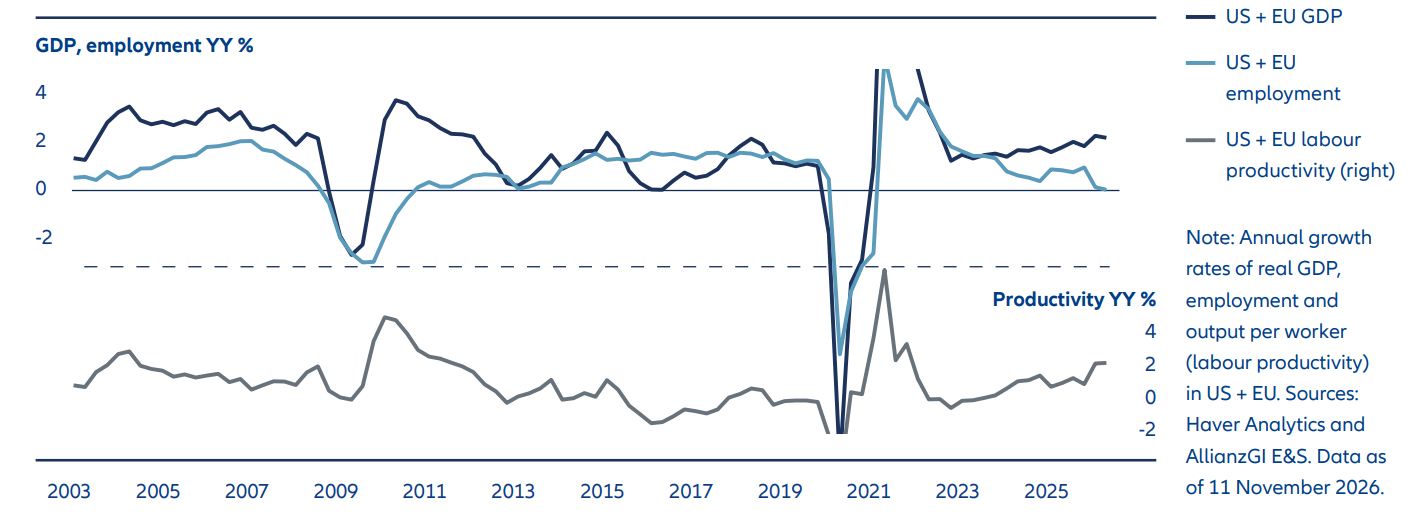
Exhibit 1: Economic growth has raced ahead of employment growth – can they reconnect?
Note: Annual growth rates of real GDP, employment and output per worker (labour productivity) in US + EU. Sources: Haver Analytics and AllianzGI E&S. Data as of 11 November 2026.
Volatility could emerge in Europe, offering opportunities for bonds
France is likely to be a focal point for volatility in Europe. Uncertainty before the spring presidential elections may weigh on French assets. The new government and the European Union (EU) will face tough choices. A deal is possible that combines growth-boosting reforms and tighter government finances with enough support for spending to avoid a recession, but we expect tense negotiations. The EU should stay united, but European risk assets may face some jittery spells before becoming an opportunity again.
As the year progresses, resilient growth may increasingly give way to signs of strain. But if central banks follow the conservative paths we expect, and focus on preventing inflation becoming ingrained, global bond markets could offer attractive opportunities to earn returns and reduce risks.
What is the one thing investors should look out for in 2027?
The key question for 2027 is whether the labour market reconnects with economic growth (Exhibit 1). Under pressure from high inflation and slowing wage growth, households have dipped into their savings to sustain spending. They may need a pick-up in hiring and wages to keep going. A recovering share of labour income in the economy could slow profit and productivity growth, however, while generating even more inflationary pressure and central bank vigilance.
From promise to proof

“Expectations for 2027 remain optimistic, but the market is increasingly asking what must be delivered, not what might be possible. In our view, equities can still generate solid returns, but with greater dispersion and less tolerance for disappointment.“
Michael Heldmann
CIO Equity
Higher yields raise the bar without closing the door
The backdrop remains supportive. Despite modest GDP growth, we expect US earnings to grow by around 16%2in 2027, and the US market currently trades on about 19 times earnings. That is not cheap by long-term standards, but valuations are less stretched than in recent years and do not, on their own, warrant caution.
What has changed is the competition for capital. With 10-year US government bond yields around 5%3, investors may receive very little for taking on equity risk, though the promise of potential earnings growth – rather than a fixed coupon – remains attractive. Higher yields do not undermine the case for equities, but they change which equities make the case. Companies whose valuations rest on cash flows far in the future face a tougher test than those that can demonstrate earnings and distributions today.
The AI test: from build-out to adoption
The artificial intelligence (AI) investment cycle remains the largest single influence on earnings expectations, capital expenditure, and market performance, and it is where the gap between promise and proof matters most. The question for 2027 is not whether the technology is transformative, but whether the enormous sums being invested translate into profits.
We expect attention to shift from the builders of AI infrastructure towards the businesses that use it profitably. Scarce capacity should continue to support parts of the market, notably memory and power infrastructure, but a good deal of enthusiasm is already reflected in prices. Our preference is for broader beneficiaries over concentrated semiconductor winners, and for companies that can show AI lifting revenues or lowering costs in reported results.
Compelling opportunities in Europe and Asia Pacific
In a world of higher hurdles, we look for opportunities where earnings delivery is visible and valuations leave room for it. Europe is the clearest example of a story moving from policy to profits. Spending on strategic autonomy initiatives should become visible in company earnings in 2027, and the opportunities extend from defence into energy infrastructure, power grids, and parts of the European semiconductor supply chain. The path may not be smooth, with French elections, the European Central Bank, and energy prices all capable of creating volatility, but the direction of travel is supportive.
In Asia Pacific, AI opportunities remain concentrated in South Korea, Taiwan and Japan, and we would look for breadth beyond the most crowded semiconductor names. Japan remains attractive due to ongoing governance reforms, a normalising monetary policy, and fiscal support; India is worth reassessing after its correction; and we remain constructively selective on China.
Value remains a key source of portfolio diversification, and the emphasis here is on quality of income. We prefer sustainable dividend growth over headline yield, focusing on companies able to raise payouts consistently, and financials remain a preferred area.
What will separate winners from losers
As dispersion widens over the coming year, we expect several company characteristics to separate the winners from the losers. The first is earnings visibility: businesses that can convert investment into reported profit on a credible timeline will be rewarded, while those that rely on the promise of future returns will be questioned. The second is balance-sheet and cash-flow strength, which matters more when capital is no longer cheap. The third is pricing power, which becomes critical if energy costs and inflation prove sticky. The fourth is the consistency of returning capital to shareholders; companies able to fund investment while still growing dividends demonstrate a quality of earnings that the market is increasingly willing to pay for.
What could go wrong
Our constructive view comes with caveats, and four stand out. The first is the risk of escalation in the Middle East, where there is still no durable solution. The second is high energy prices, which weigh on margins and consumers alike. The third is renewed upward pressure on inflation, which could keep yields higher for longer and cap valuations. The fourth is disappointment with AI delivery, which would challenge some of the most demanding expectations in the market.
These risks are not independent. Renewed Middle East tension could push energy prices higher, feeding inflation and keeping interest rates elevated. Higher yields, in turn, make valuations less forgiving of any shortfall in AI delivery. This interaction is why we think the balance of risks has shifted, even though our central view remains positive. The new balance of power in the US Congress is unlikely, in our view, to alter this picture materially. It may influence where gains are concentrated, with healthcare, energy, and financials the most sensitive to shifts in policy, but the main determinants of returns remain interest rates, earnings, and the AI cycle. These sectors are most exposed to the policy areas Congress may change, such as drug pricing, energy regulation, and bank oversight.
A structural change in supply
One development deserves a mention because it marks a clear break from recent history. For roughly two decades, the net supply of US equities has been shrinking as companies bought back more shares than they issued. That is beginning to change, with larger initial public offerings coming to market. For investors, this offers new access to companies, but it also means a new source of supply to absorb. How these listings perform will say a good deal about investor appetite and the market’s capacity to take on new issuance.
What is the one thing investors should look out for in 2027?
The key question for 2027 is whether AI can deliver on its promise of earnings growth. With higher yields, energy prices and geopolitical risk raising the bar, we believe investors should be selective. Proven results, rather than ambition, will distinguish winners from disappointments.
Bonds are back

“Yields have risen to multi-year highs in 2026. This reinforces an important change in the investment landscape as we enter 2027: fixed income once again offers meaningful income and diversification benefits. At today’s starting yield, we don’t need a recession, nor do we need to get the Federal Reserve’s next move exactly right to make a case for bonds. High starting yield and a reasonably stable economy can be enough: borrowers continue paying, and income has time to accumulate.
For 2027, we believe investors should return to a more traditional fixed-income discipline: underwrite carefully, whether it is a sovereign, a corporate or a structure, and give income time to compound. Bonds are back, but an active and selective approach is essential in 2027.“
Jenny Zeng
CIO Fixed Income
We don’t need a recession to make the case for US Treasuries
After years of brutal repricing, real yields on US Treasuries now present a much more compelling opportunity. We believe the 10-year US Treasury yield is closer to its theoretical fair-value range, broadly consistent with nominal growth, at around 4.5% to 5% in this cycle4. Of course, higher capital requirements and heavy government borrowing could push Treasury yields above this range, while concerns about the sustainability of artificial intelligence (AI) spending and the growth outlook could pull yields below it.
At current yield levels, long-term investors are being paid meaningful carry – the income earned from holding a bond over time – providing them with a substantial cushion against adverse price movements. That is an important change in the investment equation. Investors no longer need a recession, and the sharp fall in yields that would typically accompany one, to generate an acceptable return from bonds. At these yield levels, carry itself can do much more of the work.
To be clear, we are not making a call for yields to fall significantly from here. The US economy continues to combine relatively strong nominal growth with inflation above the central bank’s target. That limits the scope for aggressive monetary easing and makes a sustained duration rally less obvious. But there is also an important asymmetry. Should US growth disappoint, or equity-market volatility rise materially, US Treasuries could once again provide some of the defensive characteristics traditionally associated with government bonds.
Credit still offers opportunities, but buyer beware
The other side of higher yields is a higher cost of capital for borrowers. So far, the pressure has been concentrated primarily among the weakest borrowers, particularly in lower-quality segments (see “one thing to look out for”). The question for 2027 is whether that stress begins to migrate up the credit-quality spectrum. This is where active credit selection becomes particularly important. Credit investing has always been asymmetric: the upside from getting a credit right is finite, while the downside from getting it badly wrong can be substantial. Avoiding ‘landmines’ that can cause permanent capital impairment is fundamental to successful credit investing.
That philosophy becomes especially relevant when credit spreads are relatively tight while the underlying cost of financing remains high. Rather than taking indiscriminate credit risk, we believe investors should focus on balance-sheet resilience, refinancing schedules, free-cash-flow generation and companies’ ability to absorb higher cost of capital.
AI: believe in the technology, but scrutinise the financing
AI remains one of the most powerful structural investment themes in the global economy. But an important distinction needs to be made between believing in the technology and believing that every investment made in its name will generate an adequate return.
The scale of investment in data centres, computing infrastructure and power generation is extraordinary, and that build-out is likely to continue despite potential policy headwinds following the US midterm elections. Temporary dislocations are normal during any major investment boom and are not, by themselves, evidence of systemic collapse. But history teaches us that there will be casualties, just as there were during previous infrastructure booms involving railways, the power grid and the internet. Late movers, overleveraged players and those lacking scale or genuine differentiation are most vulnerable.
We think 2027 may see some of those casualties start to surface. For credit investors, that means paying particular attention to visibility of cash flow generation, leverage trajectories, off-balance-sheet obligations, vendor financing and increasingly complex funding structures around AI infrastructure.
AI may remain the defining investment theme of the future, but the next phase is likely to be less about the amount of capital spent and more about what returns are generated.
Floating-rate and emerging market debt broaden the opportunity set
The opportunity in fixed income extends beyond traditional fixed-rate government and corporate bonds. Floating-rate assets can remain attractive when uncertainty around the path of policy rates is high. We see particular merit in higher-quality floating-rate instruments, including investment-grade floating-rate notes and selected exposure to collateralised loan obligations, where investors can capture attractive income while limiting duration risk.
Emerging market debt also offers interesting opportunities to generate attractive carry. But here too, selection is critical, particularly when valuations are no longer uniformly cheap. Inflation trajectories, fiscal positions, external financing dynamics and policy constraints vary considerably. We therefore favour selective exposure rather than treating emerging market debt as a single macro trade.
Resilient income is what portfolio construction seeks to retain
Higher starting yields have generally been associated with better subsequent bond returns. But credit losses, transaction costs and excessive exposure to interest-rate or spread risk can all erode that income. Resilient income needs to be constructed, not simply harvested.
The central message for 2027 is simple. Higher yields have made fixed income more attractive, but they have also made the consequences of poor capital allocation more severe. The objective should be to build portfolios that can compound attractive income while remaining resilient across a range of economic outcomes. That requires discipline in taking risk, intellectual rigour in research and, perhaps most importantly, a willingness to challenge assumptions that were formed during a very different interest-rate regime.
What is the one thing investors should look out for in 2027?
So far, much of the pain from higher financing costs has been concentrated among CCC-rated borrowers and other highly leveraged companies. The critical signal in 2027 would be a more sustained deterioration among single-B and eventually BB-rated issuers, particularly in rate-sensitive or highly leveraged sectors such as consumer cyclicals, software and communications. If that happens, it would suggest that higher rates are no longer exposing weak borrowers at the margin, but are being transmitted into the broader corporate sector and potentially the real economy.
Diversifying in a more demanding market

“We are constructively positioned for 2027 and continue to favour risk assets, although selectivity and active allocation will become increasingly important. Stronger growth supports the investment environment, but geopolitical fragmentation, rising government debt and competition for capital will increase market dispersion, including through higher bond yields and elevated oil prices.
Artificial intelligence (AI) will remain one of the most important structural market drivers. Capital is flowing into the wider ecosystem, and deployment is spreading across more industries and geographies. But elevated valuations in some areas mean selectivity remains essential.
We remain broadly risk-on, but less so than 12 months ago. We prefer equities over bonds tactically in what still appears to be a predominantly mid-cycle environment, but financial conditions may become more restrictive as the year progresses.
The challenge is to recognise when relative attractions change while building portfolios that can withstand a wider range of outcomes.“
Gregor MA Hirt
CIO Multi Asset
A higher hurdle to clear
For many years, extremely low or negative interest rates left investors with few alternatives to equities. That world has changed as interest rates rise. Government bonds and selected credit markets now offer meaningful income, so all asset classes must clear a more demanding return threshold. The hurdle rate for equities and other risk assets has risen materially. The speed of further rate increases will be critical to determining the impact on equity markets, as some companies may not be sufficiently hedged against higher borrowing costs.
Within global equity markets, resilient earnings growth remains the key support, continuing to offset tighter monetary policy and energy-related risks. We prefer emerging markets, which benefit from exceptionally strong earnings growth while remaining under-owned globally. The AI cycle in South Korea and Taiwan may provide further support. However, valuations have become more demanding, while widening dispersion in country- and sector-level risks across the emerging market universe has reinforced the need for careful selection and active allocation.
US equities benefit from robust AI-led earnings, but elevated valuations and rising real yields require judgement. Japan appeals because of a weak currency, improving earnings revisions and policy reform; the euro zone benefits from improving growth despite energy and stagflation risks.
Overall, we have moderated our AI allocation, although opportunities extend beyond the initial leaders to power systems, data centre infrastructure, optical interconnects, advanced materials and Asian hardware suppliers. As deployment broadens, investors should distinguish between businesses enabling adoption and those turning heavy spending into durable returns.
Government financing needs and investment in AI, energy infrastructure and defence reflect a more capital-intensive economy and may keep rates above the norms of recent years. Markets increasingly treat this as an enduring higher neutral-rate regime, although structural models still point to comparatively low neutral rates, challenging the permanence of higher for longer.
“Bond land” is back, but selectivity is key
One of the clearest implications of higher interest rates and bond yields is that fixed income has regained a meaningful role in portfolio construction. Bond markets once again offer income and carry potential – “bond land” is back.
Higher starting yields improve the strategic case for government bonds, but for now we prefer selective opportunities to a broad move into duration. US Treasuries face hawkish policy expectations, weak fiscal discipline and heavy competing issuance, while euro zone sovereigns are constrained by energy-related inflation, fiscal strains and political stress in France.
We continue to see value in selected credit markets and emerging market debt, particularly where real yields remain attractive and fiscal conditions are supportive. We also favour higher-quality investment-grade exposure over taking excessive credit risk at this stage of the cycle.
Elevated real yields make inflation-linked bonds attractive, offering protection if inflation persists or growth disappoints, as well as diversification within multi asset portfolios.
The timing of a move into duration remains crucial. Attractive valuations need confirmation from clearer monetary policy and evidence that tighter financial conditions are slowing growth, and stronger technical and momentum signals.
If those signals emerge in 2027, our conviction in duration could rise significantly, especially if market pricing of a higher neutral rate converges towards lower structural estimates.
Diversification is not dead, but it requires a rethink
Debate over the traditional 60/40 portfolio (60% equities and 40% bonds) has resurfaced in the investment community. Although the approach has generally proved resilient over decades, holding the combination alone does not guarantee full diversification.
Higher inflation and rising interest rates have weakened the diversification benefits of adding bonds to an equities portfolio, because both lose value when rates rise. This could explain why in recent equity drawdowns, bonds offered less protection. Both are also exposed to other common forces, such as liquidity and economic growth. Therefore, investors should identify the risks driving each allocation and test how the portfolio might respond under different scenarios.
Commodities can be useful diversifiers because they have generally shown low or negative long-term correlations with equities and bonds, especially when inflation rises.
We favour commodities where structural demand meets constrained supply: oil benefits from tight supply, while copper is supported by grid investment and persistent supply constraints. We retain gold exposure because fiscal deficits and central bank demand offer medium-term support, but its strategic case is weaker than two to three years ago, when real rates were low and the US dollar was depreciating.
Currencies can diversify portfolios and cushion economic shocks. The US dollar can also act as a liquidity haven during periods of market stress, reinforcing its tactical diversification role. We are moderately positive on the US dollar against the euro, supported by higher US yields and resilient growth, but longer-term pressure may come from its high valuation, US fiscal concerns and persistent de-dollarisation.
Elsewhere, we see further appreciation potential in the Japanese yen, which could put additional pressure on the Swiss franc as an alternative funding currency.
Stay invested, but stay agile
In summary, we believe investors should remain invested in 2027, but with greater selectivity and flexibility than in recent years.
This wider opportunity set strengthens the case for active allocation. As correlations and expected returns change, static allocations may become less effective, while multi asset portfolios can adjust exposures as the balance between growth, inflation and policy evolves.
With the investment bar now higher, disciplined rebalancing, diversification and agility will matter more than ever.
What is the one thing investors should look out for in 2027?
The key signal for 2027 will be when attractive bond yields are matched by a clearer economic case for owning bonds. If it becomes clearer that interest rates have peaked and higher borrowing costs are slowing the economy, investors may start shifting more decisively from growth assets towards duration and income.
Fundamentals, selectivity and manager dispersion

“Private credit and private equity enter 2027 at an important point in their development. Private credit is evolving as investors place greater emphasis on borrower fundamentals, portfolio resilience and the quality of returns, while private equity is looking for a more sustained recovery in exits and distributions. Across both markets, higher financing costs and a more demanding investment environment reinforce the importance of disciplined underwriting, operational expertise and manager selection. Structural opportunities remain across both markets, but outcomes are likely to depend less on broad market exposure and more on the ability to identify attractive entry points, manage downside risks and demonstrate sustainable value creation.“
Sebastian Schroff
CIO Private Credit and Private Equity
Private credit: focus on fundamentals
The next phase of private credit should reward selectivity rather than indiscriminate allocation. Attractive risk-adjusted opportunities are likely to emerge where borrowers have genuine financing needs, lenders can negotiate meaningful protections, and repayment depends on sustainable cash generation rather than favourable refinancing conditions.
Europe and Asia Pacific offer opportunities to diversify private credit exposure beyond the US, with different borrower profiles, lending markets and financing needs. Europe’s bank-centred financial system creates scope to provide flexible capital to established businesses, while Asia Pacific’s structural financing needs and expanding non-bank lending markets offer exposure to different growth drivers. Both require careful assessment of local legal frameworks, currency risks and creditor protections.
The investable universe also extends beyond sponsor-backed corporate lending to infrastructure debt, asset-backed and trade finance, secondaries and special situations. In each case, returns must adequately compensate investors for complexity, illiquidity and potential losses.
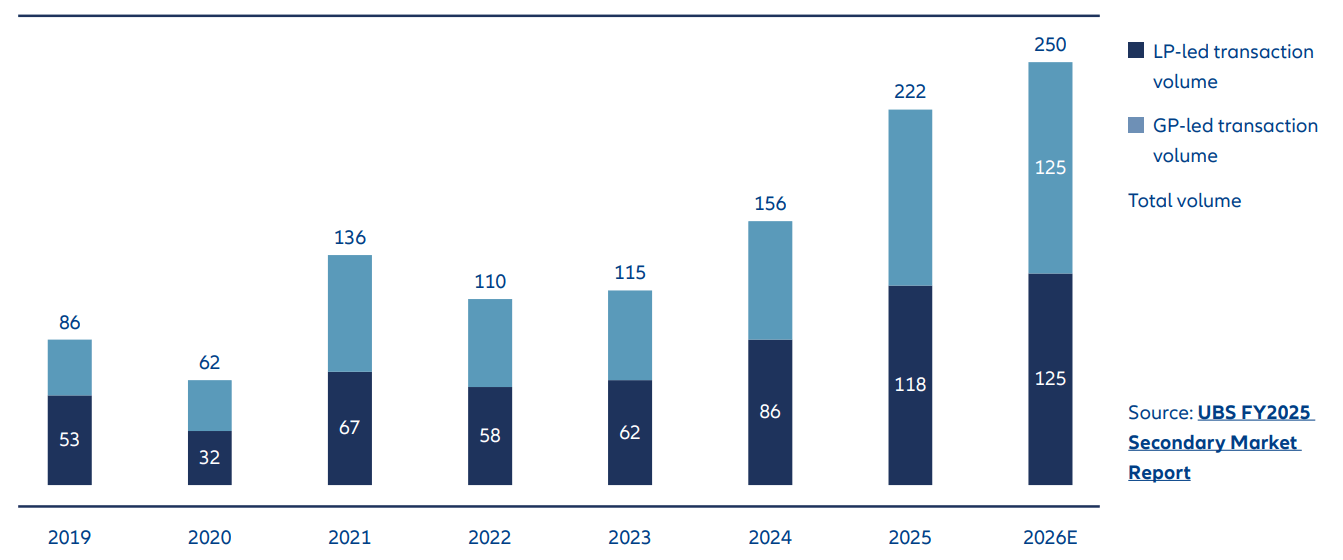
Private credit secondaries offer access to seasoned portfolios, established managers and potentially shorter investment horizons than primary commitments. They can also provide liquidity to existing investors and allow managers to retain assets through continuation vehicles. Transaction volumes nearly doubled from USD 10.9 billion in 2024 to USD 20 billion in 2025, highlighting the market’s rapid development.5 This compares with a total estimated market size of USD 250 billion for private markets secondaries in 2026 (Exhibit 2).6
Exhibit 2: Private markets secondaries continue their strong growth
Source: UBS FY2025 Secondary Market Report
Despite this growth, secondaries remain a relatively small part of private credit, so the figures point to an expanding source of liquidity rather than a mature market. Pricing is another consideration as buyers may be able to acquire investments for less than their reported net asset value (NAV). However, discounts do not automatically represent value: buyers must independently assess underlying credit quality, valuations, documentation and repayment prospects.
Rising dispersion is increasing the importance of looking beyond headline default rates. Payment-in-kind (PIK) income, amendments, extensions, leverage and restructurings provide a more complete picture of underlying credit health and help distinguish viable borrowers experiencing temporary pressure from fundamentally impaired businesses.
For disciplined lenders, this can create attractive entry points. Rigorous underwriting of downside scenarios, cash-flow resilience and debt-service capacity, combined with strong documentation and meaningful intervention rights, can help identify stronger credits. Periods of greater uncertainty can therefore allow lenders to finance high-quality businesses at more attractive spreads, with stronger structures and better lender protections.
Competition for deployment makes this discipline particularly important. Reuters reported that direct-lending funds raised USD 129.15 billion in the first nine months of 2026, up 35% year on year, while third-quarter lending volume fell 28%.7 This divergence points to greater competition for attractive transactions and reinforces the importance of maintaining lending discipline.
Private equity: exits hold the key to recovery
Private equity could improve in 2027 if financing conditions become more supportive and buyers’ and sellers’ valuation expectations converge. The clearest signs of recovery will be completed exits and cash distributions to investors, rather than deal announcements alone. Slower distributions can constrain limited partners’ capacity to commit to new funds, even where portfolio companies continue to perform.
The strongest opportunities are likely to involve businesses where managers can create value through operational improvement rather than rely primarily on cheaper debt or higher exit multiples. Revenue growth, margin improvement, technology adoption, international expansion and targeted acquisitions can all contribute to performance.
Artificial intelligence (AI) creates opportunities to improve productivity and develop new services but may also challenge established business models. Investors must distinguish companies that can use AI to strengthen their competitive position from those exposed to technological disruption. Secondaries may also provide opportunities through seasoned portfolios and GP-led continuation vehicles, but pricing, asset quality, governance and alignment of interests remain essential.
Manager selection and transparency become critical
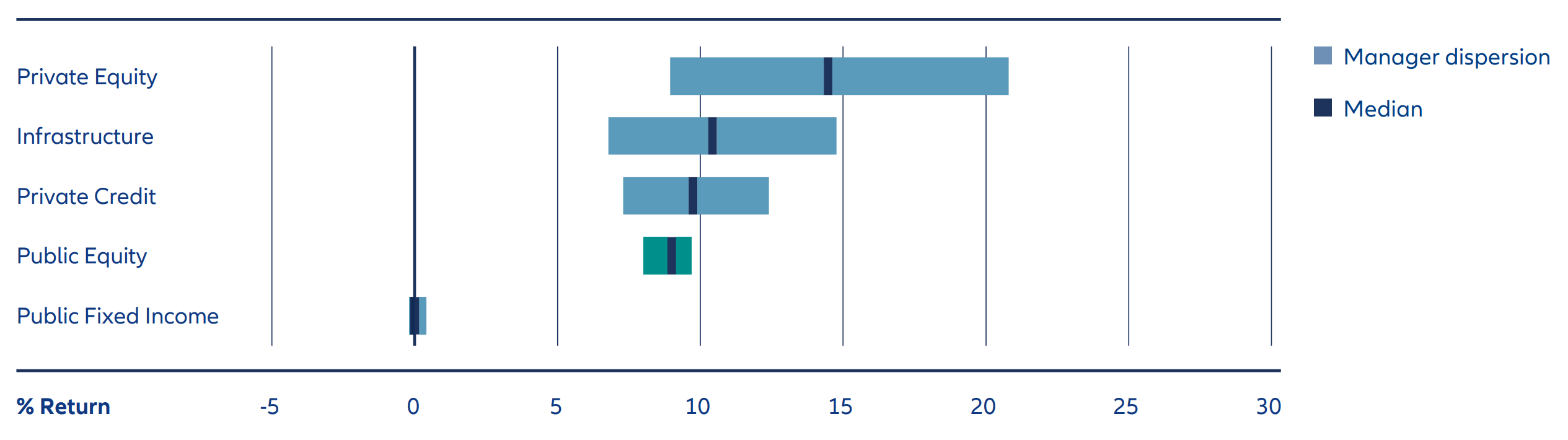
In both private credit and private equity, dispersion in manager performance makes selection increasingly important (Exhibit 3). Differences in sourcing, underwriting, leverage, operational execution and valuation can lead to materially different outcomes. Historically, benign credit conditions may have masked differences in portfolio quality among directlending managers, with relatively limited dispersion in performance. As conditions become more demanding, those differences may become more visible, putting greater emphasis on manager skill and discipline.8
Exhibit 3: Private market returns vary widely between managers, making manager selection critical
Sources: Private Equity, Infrastructure and Private Credit: Preqin Benchmarks (Private Markets Performance Data, Q2 2025 edition), net IRR, average of 2013-2022 vintage-year upper- and lower-quartile boundaries (Private Credit = Preqin ‘private debt’); Tick shows average vintage median. Public Equity (Morningstar US Large Blend) and Public Fixed Income (Morningstar US Intermediate Core Bonds): five-year annualised returns of open-end funds, 1 October 2018-30 September 2023, as published by Blackstone, ‘Manager Selection is Key in Private Markets’, The Connection. Infrastructure sector dispersion: MSCI, ‘Greater Divergence of Returns in Infrastructure than Real Estate’ (6 October 2025), based on the MSCI Global Quarterly Private Infrastructure Asset Index and MSCI Global Quarterly Property Index (average cross-sectional dispersion of 12-month rolling returns). Bars show the range from the bottom quartile to the top quartile of managers/funds; markers show the median. Comparisons between private and public markets involve important methodological differences, including valuation frequency, liquidity, leverage, cash-flow timing, fund-universe construction (fund-level IRR by vintage versus trailing five-year fund returns), measurement period and benchmark construction; periods shown are not identical. Public peer groups are US-focused and may not be representative of global public markets. Private market returns are net of fees and carried interest where reported. Historical performance is not indicative of future results. Figures are shown for illustrative purposes only and should not be interpreted as investment advice or a guarantee of future performance.
Therefore, transparency is a competitive differentiator. Investors need clear reporting on borrower health, cash income, portfolio company performance, valuation assumptions, leverage and emerging risks. They should be able to distinguish realised returns from unrealised valuations and understand how performance is generated.9
This matters as private markets become more accessible to wealth management clients through European Long-Term Investment Funds (ELTIFs) and evergreen or other semiliquid structures.
What is the one thing investors should look out for in 2027?
Private markets are entering a more selective phase, where fundamentals and manager selection matter more than ever. In private credit, disciplined underwriting is key to navigating credit risks; in private equity, a recovery in exits and distributions will be critical. Across both, transparency and sustainable value creation will distinguish the strongest managers.
Financing energy resilience and the digital build-out

“Infrastructure is entering a new investment phase, shaped by rising electricity demand, artificial intelligence (AI), electrification and geopolitical efforts to strengthen economic security. Governments and businesses are placing greater emphasis on reliable energy, resilient supply chains and control over critical digital systems. These priorities create long-term investment needs across power networks, storage, data centres, transport and other essential assets. Yet structural demand does not automatically translate into attractive returns. As capital becomes more selective, identifying bankable opportunities, structuring resilient cash flows and managing execution risk will be central to performance.“
Marta Perez
CIO Infrastructure
Themes shaping the opportunity
The strongest themes sit at the intersection of energy security, electrification and digitalisation. AI and data centres are increasing electricity demand, while electrification is shifting more activity onto power grids. Geopolitical uncer-tainty is also elevating the importance of reliable domestic energy systems and strategic autonomy. Data sovereignty, or control over where data is stored, processed and governed, is increasing the importance of secure data centres, fibre and telecom networks.
However, digital infrastructure is only as investable as its supporting power supply. Grid access, connection timelines, equipment availability and customer commitments can determine whether demand translates into cash flow. Investors should distinguish contracted demand from speculative development pipelines and consider how technological change may affect facility design, cooling requirements and future capital expenditure.
Electricity grids are central to the transition. The International Energy Agency estimates that more than 2,500 GW of renewable, storage and large-load projects are waiting in grid connection queues worldwide.10 It also estimates that annual grid investment will need to rise by roughly 50% from around USD 400 billion currently to meet demand through 2030.11 Grid upgrades and interconnections offer long-term opportunities, while storage and other flexibility solutions support reliability and renewable integration. Returns nevertheless depend on regulation, connection arrangements and the balance between contracted and merchant revenues.
Transportation can also prove attractive. Ports, railways, roads and logistics networks underpin the movement of goods and people. Supply chain realignment and regionalisation may enhance the strategic importance of transport corridors and logistics capacity – but not shield them from economic cycles. Investment prospects still depend on traffic, economic activity, concession terms, regulation and ongoing capital expenditure.
Separating attractive investments from the rest
A compelling theme is only the starting point. Investors must understand who pays, under what contractual or regulatory framework, and how revenues respond to inflation, weaker demand or disruption. Operating assets may offer more predictable cash flows but still face refinancing, regulatory, cost and capital-expenditure risks. Development assets offer growth potential but add construction, permitting, commissioning and connection risks. Expected returns should reflect these risks and who is best placed to manage them.
Execution is particularly important across energy and digital infrastructure. Planning, permitting and completing new grid infrastructure can take 5-15 years, compared with 1-3 years for data centres.12 A data centre may have customers and financing in place but still fail to generate expected cash flows if its power connection is delayed. Investors should scrutinise grid access, permits, construction schedules, equipment supply, commissioning milestones and the consequences of delays.
Manager dispersion reinforces the importance of selection. Sourcing, entry valuation, contractual structuring and asset management can produce very different results within the same sector. Investors should look beyond headline returns to understand the drivers of performance, remaining capital expenditure, and sensitivity to changes in demand, power prices and regulation.
Transparency is a competitive differentiator. Investors need visibility on asset-level performance, construction milestones, operating costs, capital expenditure, contractual protections and valuation assumptions.
Three areas of opportunity
Three areas stand out. First, essential networks – including grid reinforcement, interconnection and regulated utilities – can benefit from sustained investment needs. Their attractiveness depends on regulatory stability, allowed returns, financing requirements and the ability to deliver projects efficiently.
Second, operating energy-transition assets and selective storage investments can offer exposure to electrification and system flexibility. Battery storage can help reduce grid congestion and balance electricity supply and demand, although investment outcomes depend on market design, technology, operational risks and the extent to which revenues are contracted or exposed to power-price volatility.
Third, digital and transportation infrastructure can provide structural growth where demand is supported by credible customer commitments, reliable power access, durable concessions or essential network roles. Development investments may also be attractive where construction and execution risks are identifiable, appropriately priced and allocated to parties capable of managing them.
Infrastructure secondaries offer another route into the asset class, providing access to seasoned portfolios of operating assets and established cash flows. They can give existing investors liquidity and allow managers to retain attractive assets through continuation vehicles. For buyers, they offer an alternative to primary commitments, with more visibility into asset performance and remaining investment needs. Pricing, asset quality and alignment of interests remain critical.
Diversification should be assessed by underlying risk drivers rather than sector labels alone. Renewable generation, storage and data centres may share exposure to grid access, power prices or customer demand. Transport assets may be exposed to common trade and economic cycles. Resilience depends on understanding these connections, not simply holding assets across different categories.
For long-term investors, the most attractive assets will be those that remain useful across a range of plausible economic and geopolitical outcomes. In 2027, the ability to translate structural demand into resilient, long-term cash flows will be as important as identifying the next high-growth theme.
What is the one thing investors should look out for in 2027?
The key signal for 2027 will be whether power and grid capacity can keep pace with rapidly rising demand. For data centres and other energy-intensive infrastructure, access to reliable power and timely grid connections will increasingly determine which projects can translate structural demand into resilient cash flows. Disciplined investment and risk management will be critical.
Sources
1 Source: Allianz Global Investors, November 2026.
2 Source: Allianz Global Investors, November 2026.
3 Source: US Federal Reserve, 2 November 2026.
4 Source: Allianz Global Investors, November 2026.
5 Source: Evercore, 2025 Credit Secondary Market Survey, January 2026. Figures are Evercore estimates.
6 Source: UBS FY2025 Secondary Market Report.
7 Source: Reuters, “Private credit faces deployment squeeze as fundraising hits record,” 15 October 2026.
8 Source: Cambridge Associates, “A New Era of Dispersion in Direct Lending Favors Disciplined Managers
9 Source: Preqin / BlackRock, “Private markets benchmarks enter their next era,” 13 August 2026.
10 Source: International Energy Agency.
11 International Energy Agency (IEA), Electricity 2026.
12 International Energy Agency (IEA), Electricity 2026.