

Equity
Global Equity Compass: Nov 2026


A more discerning market
|
Equities entered the final months of 2026 on a more selective footing. October saw investors scrutinise the assumptions behind some of the year’s strongest performers, particularly in AI. Rather than questioning AI’s potential, markets appear focused on whether today’s exceptional investment can translate into tomorrow’s earnings. We strongly believe markets are being impatient: pricing a payoff years away requires staying the course.
This is reshaping the market. Areas outside tech are attracting greater attention, while some AI beneficiaries have come under pressure. Headline moves increasingly conceal wide differences.
For investors, this may be a healthy development. Strong themes such as AI remain important, but valuations, earnings delivery and capital discipline are likely to matter more. With bond yields elevated and geopolitical uncertainty ongoing, the environment is rewarding selectivity: identifying not just where growth is occurring, but which companies are best placed to turn it into sustainable returns. |

Global Equity Compass | What to watch
1 A higher hurdle for equities
Elevated government-bond yields are raising the return required from equities. With some valuations stretched, companies may need to demonstrate stronger earnings growth, reliable cash generation, and disciplined use of capital to justify valuations. This could increase dispersion between businesses that deliver and those relying on optimistic expectations.
2 From spending to returns
After several years of exceptional investment in chips, data centres and computing infrastructure, investors are now focusing on which companies can turn AI adoption into productivity gains and profits. This could further broaden opportunities beyond the companies building the infrastructure to businesses using AI to improve operations and strengthen positioning.
3 Putting ambition to work
Europe’s drive for autonomy is moving from commitment towards implementation. Investment in defence, energy, semiconductors, and industrial capacity could become visible in order books and earnings. Opportunities may begin to extend beyond the obvious beneficiaries to the suppliers, tech providers, and industrials enabling Europe’s ambitions.
Equity market data

Source: Allianz Global Investors E&S team, 30 October 20261
Market review – style lens
- Stocks benefiting from strong market trends (“Momentum”) experienced a reversal in October, falling sharply after September’s strong rebound. The decline suggests investors rotated towards previously overlooked areas of the market, as greater dispersion created opportunities beyond established winners.
- “Quality” also struggled in October, after holding up relatively well through much of the year. Companies characterised by resilient earnings, strong balance sheets and dependable cash flows lost ground as investors showed greater willingness to embrace cheaper and more cyclical areas of the market.
- Attractively valued stocks (“Value”) were the clear beneficiaries of October’s rotation, reversing September’s weakness. As investors increasingly recognised opportunities among companies trading at more modest valuations, market participation broadened beyond expensive growth-oriented stocks and attention shifted towards a wider range of sectors and businesses.
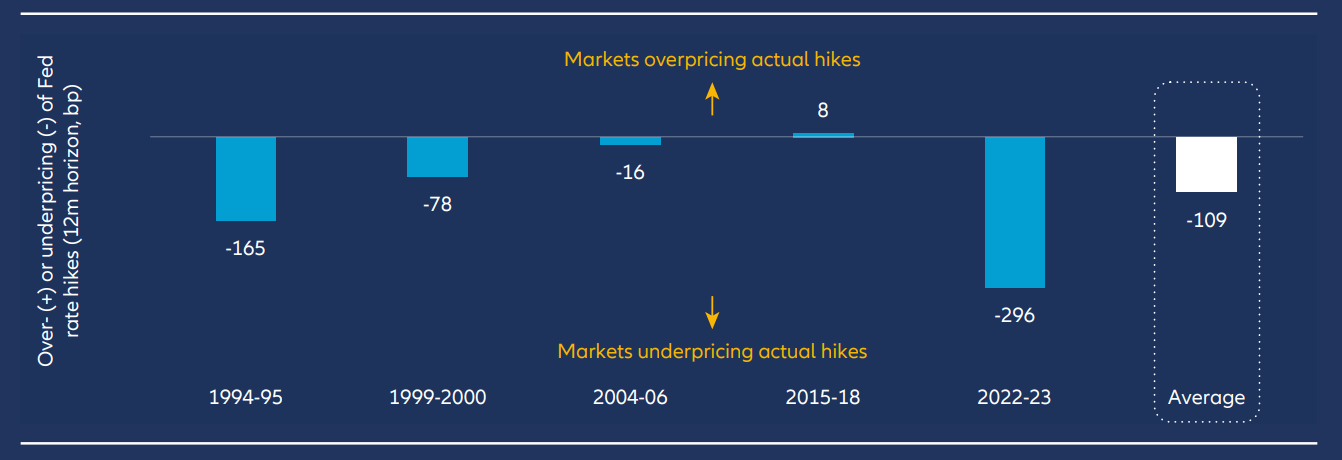
Chart of the month: markets have historically underpriced Fed tightening
Source: LSEG/Allianz Global Investors, November 2026.2
Before the Fed starts hiking, markets tend to expect too little. The chart compares what money markets priced in on the eve of each of the last five hiking cycles with the tightening the Fed delivered over the following 12 months. In four of five cycles, markets fell short: by 165bp in 1994- 95, 78bp in 1999-2000, 16bp in 2004-06 and 296bp in 2022-23. The average shortfall stands at 109bp.
For equity investors, the implication is that the starting level of rate expectations has been an unreliable anchor for valuations. When markets underprice tightening, the repricing of discount rates comes later and faster, putting pressure on long-duration and richly valued stocks. Investors should thus not assume that today’s priced-in path is the ceiling. Balance sheet strength, pricing power and earnings resilience become more important if rates rise further than expected.
1 The referenced indices/benchmarks are shown for general market comparisons and are not meant to represent any particular fund. An investor cannot directly invest in an index. Moreover, indices do not reflect commissions or fees that may be charged to an investment product based on the index, which may materially affect the performance data presented.
2 Data from 1929-2024. The hypothetical performance shown is for illustrative purposes only and do not represent actual performance; they do not predict future returns.